
A successful M&A transaction is a promise of future value. Yet, for too many organizations, that value stagnates in the post-close phase, often bottlenecked by a complex, poorly executed IT integration.
At Activera Consulting, we approach IT integration not as a cost center or a technical checklist, but as a critical lever for building the future-state operating model. Our goal is to secure the deal thesis by rapidly integrating systems, standardizing operations, and ensuring the combined enterprise is more efficient, secure, and resilient than the sum of its parts.
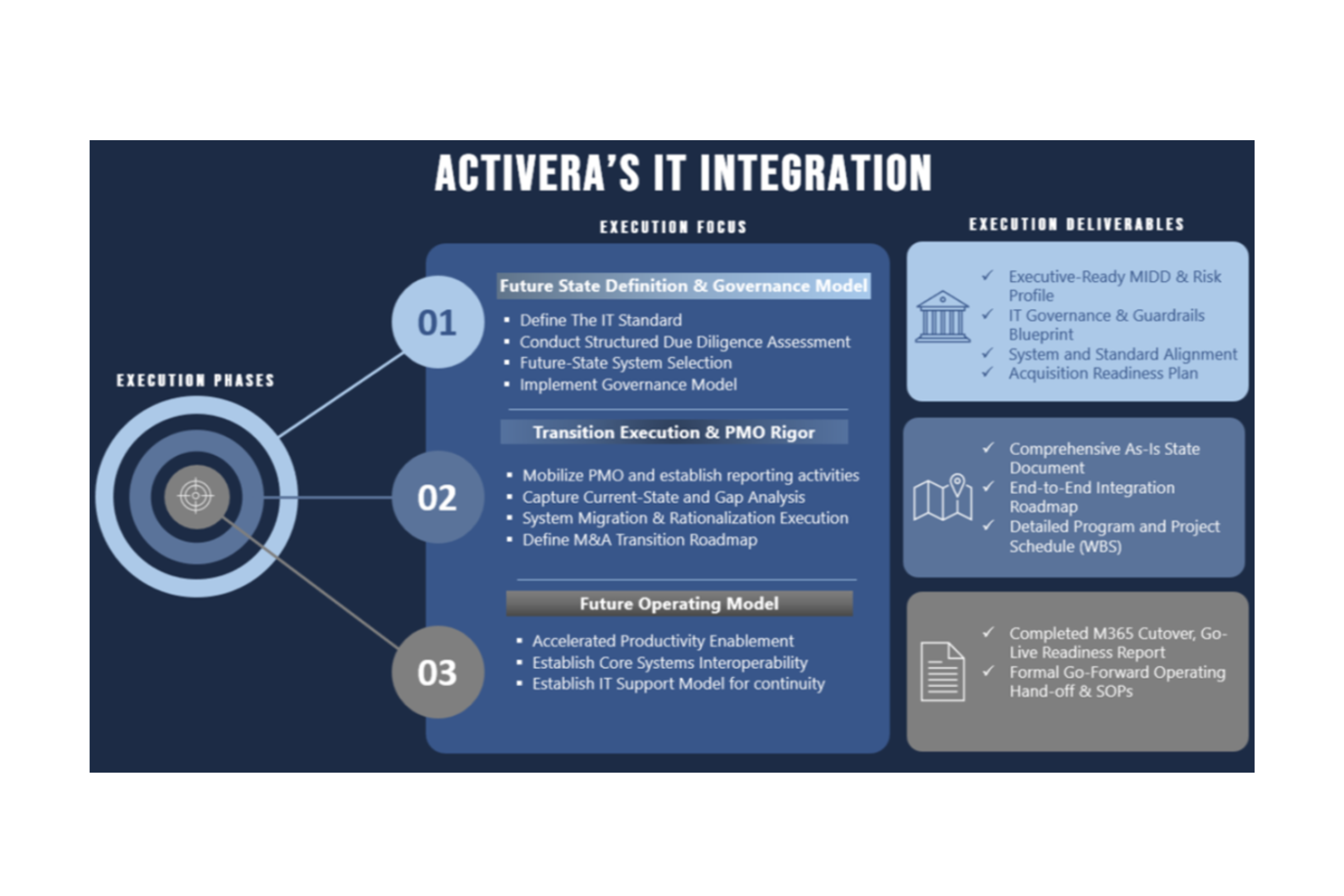
Drawing from our experience managing complex transitions, our methodology focuses on three strategic phases for sustained post-merger value.
Phase 1: Future State Definition and Governance Model
The greatest threat to deal value is the failure to establish governance and the target operating model early on. Our process focuses on defining the “destination” before initiating the journey:
- Success hinges on consensus. We work with leadership to define the IT Standards as the Enterprise Blueprint—a clear, mandatory framework covering core areas like security, compliance, data governance, and infrastructure. This serves as the guide for the new entity.
- System and Standard Alignment: We drive the strategic decision to adopt the acquiring company’s established best-in-class systems and processes where they provide clear scale, efficiency, and security advantages, ensuring the new entity benefits from the parent’s operational maturity.
- We execute a Structured Merger Integration Due Diligence Assessment to baseline the acquiree’s IT footprint and ensure alignment with all other acquisition workstreams (HR, Finance, Legal) from the start.
- Especially for organizations with decentralized business units, setting up an Explicit Governance Model is non-negotiable. This structure allows decentralized teams to maintain necessary autonomy while enforcing adherence to the strategic goals and mandated IT standards of the parent company.
Phase 2: Transition Execution and PMO Rigor
A rapid, seamless integration requires relentless focus from a Program Management Office (PMO). We apply a disciplined framework that drives accountability and maintains transparency throughout the execution phase:
- Our methodology is structured around a clear M&A Transition Roadmap, ensuring all stakeholders understand the progression from Due Diligence, through Planning for Day 1, to Transition Execution (across Cybersecurity, Infrastructure, and Applications), and finally the hand-off to operations to run and maintain.
- We conduct intensive working sessions across stakeholders to Map Current State (As-Is) of the acquiree’s entire technology footprint, mapping all core business capabilities from Inventory Management to Financial Planning & Analysis. The captured As-Is state is measured against the To-Be Standard from Phase 1 to create an actionable Gap Analysis that dictates the project plan.
- System Migration and Rationalization Execution: We manage and track the full technical implementation required to retire redundant systems and execute the migration of critical applications (e.g., ERP, CRM, HRIS) to the parent company’s standard platforms, ensuring rapid cost synergy realization.
- We manage the entire integration with a detailed, multi-level Program and Project Schedule (WBS), using MS Project to map critical path tasks, resources, and dependencies.
- Our PMO governance is driven by Transparent Status Reporting and Risk Forecasting. This cycle includes active, explicit tracking of Risk and Issue Management, and continuous Budget Monitoring (OpEx and CapEx forecasts) to ensure predictable delivery.
Phase 3: Future Operating Model
This phase connects the planning to the post-close reality, using defined standards and assessed As-Is state to architect and launch the operational reality of the new enterprise:
- Targeted Systems and Productivity Enablement: The gaps identified dictate the immediate technical workstreams: Accelerated Day 1 Productivity Enablement through immediate migration to the Parent Company’s Communication Platform (Email, Chat, MFA). Setting up Core Systems Interoperability with ERP Interface Set-up and integrating centralized data assets like the Data Warehouse. Defining a clear, Established IT Support Model like the “Smart Hands Approach” to ensure continuity of operations after the cutover.
The Activera Advantage: Delivering Strategic Outcomes
IT integration is where M&A strategy meets execution reality. By applying a structured, enterprise-grade blueprint, Activera Consulting helps leaders de-risk their acquisitions and accelerate the timeline to realize their intended business outcomes.
Ready to transform your next M&A event into a platform for growth? Connect with our M&A Integration experts.