
Energy companies today face mounting pressure to modernize operations, improve reliability, and unlock new efficiencies across the value chain. While many have demonstrated AI’s potential through pilots in areas such as equipment reliability, workforce productivity, and forecasting, the challenge remains: how do you move beyond isolated successes to enterprise‑level impact? The answer is a shift from a small, centralized AI Center of Excellence (CoE) to a fully integrated Enterprise Intelligence Organization (EIO).
An AI CoE plays a critical role in the early stages of transformation. It defines initial standards, tests promising technologies, and builds foundational talent. Yet many CoEs struggle with organizational design, operating model maturity, data readiness, and value realization. These limitations often create bottlenecks (i.e., prototypes pile up, scaling becomes inconsistent, and business engagement is reactive rather than strategic). The move toward an EIO resolves these challenges by distributing intelligence capabilities across the enterprise while maintaining strong governance and shared infrastructure.
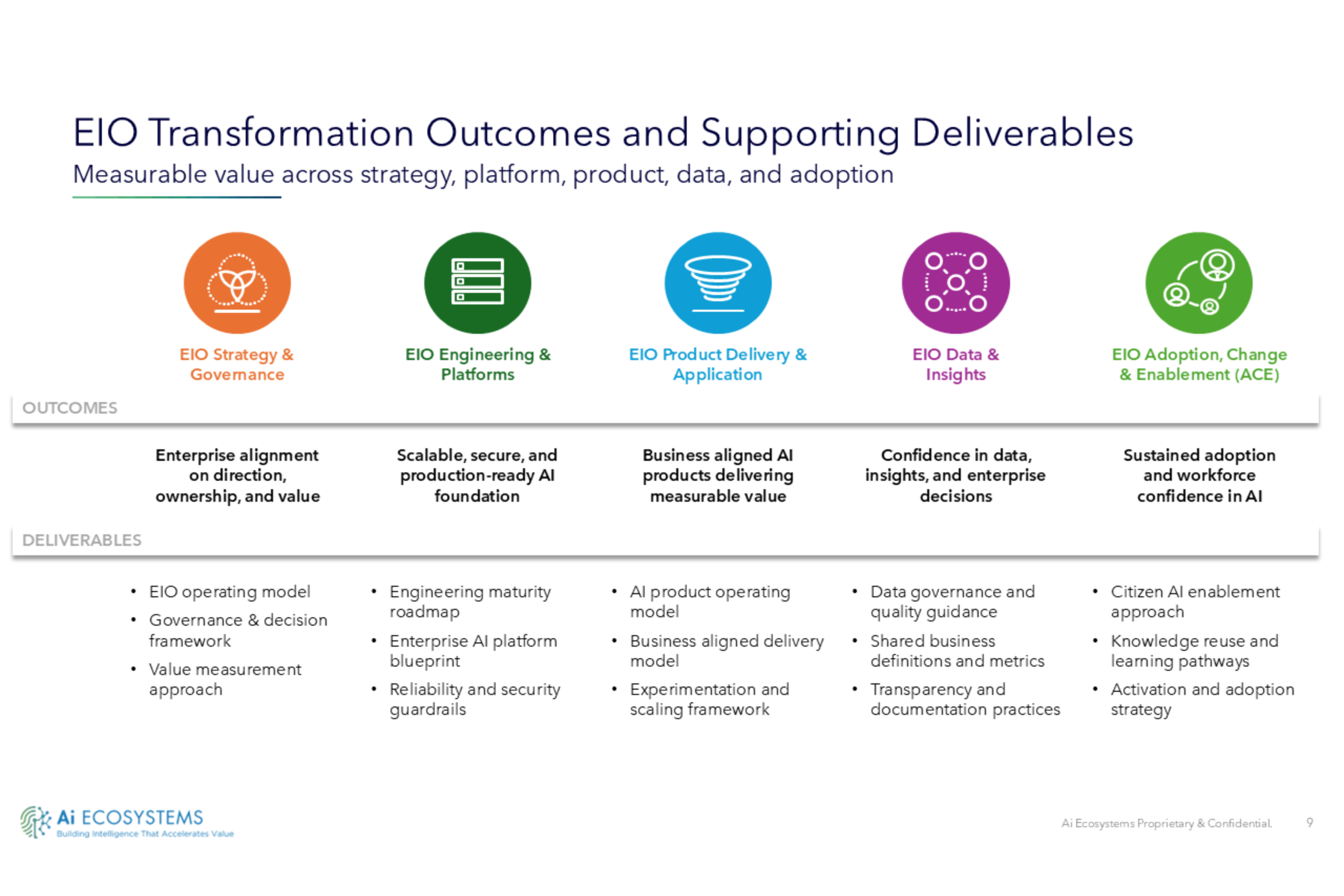
At the heart of the EIO (insert Old McDonald’s Farm joke here) model are several interconnected capabilities. The first is EIO Strategy & Governance, which establishes enterprise alignment, decision rights, prioritization frameworks, and Responsible AI pathways. This function ensures AI is not a standalone effort, but a transformation engine tied to business outcomes. Governance also defines funding principles and standardizes value measurement so investments flow toward initiatives with measurable operational impact.
Next is EIO Engineering & Platforms, arguably the backbone of scale. Many energy companies still rely heavily on prototype‑driven development and fragmented tooling. By contrast, a mature EIO implements scalable AI and data platforms, MLOps and LLMOps standards, shared components, and AI‑specific security frameworks. Engineering shifts from reactive support to structured reliability practices, enabling AI solutions to move from experimentation to production with consistency and speed.
The third pillar is EIO Product Delivery & Application, which reorients work from project‑based intake to product‑based delivery. Domain‑aligned squads with business product owners run continuous discovery, design, and delivery cycles. They apply stop‑and‑scale gates to determine which ideas should mature into enterprise products, and they embed user‑centered design to ensure AI tools are intuitive for field operators, planners, and functional users. This model increases business ownership and ensures that AI directly supports the workflows that drive value.
Trusted data and actionable insights form the fourth EIO pillar. The current‑state landscape shows fragmented data ownership, inconsistent definitions, and manual pipelines—all barriers to scalable AI. In the future‑state model, the EIO clarifies data stewardship, establishes quality principles, and transitions from one‑off datasets to reusable data products. Insights evolve from descriptive dashboards to embedded decision support, enabling teams to make faster, more confident choices. The outcome is a unified data layer that fuels AI across the enterprise.
Finally, EIO Adoption, Change & Enablement (ACE) ensures AI is actually used and trusted. Instead of relying solely on a central CoE, the EIO encourages governed self‑service, role‑based enablement, knowledge sharing, and reusable playbooks. ACE supports persona‑specific training, internal communities, and defined competency pathways. It ensures that AI adoption is measurable—not just through training attendance but through behavioral shifts, operational improvements, and increased usage of intelligence tools.
When these capabilities operate together (strategy, platforms, product delivery, data, and adoption) the result is an enterprise that treats AI as part of its operating fabric. Energy companies that embrace the EIO model can industrialize their AI capabilities while ensuring governance, reliability, and measurable value.
This shift is especially crucial in an industry where safety, reliability, and cost performance are non‑negotiable. By intentionally evolving beyond the CoE and designing AI into how work gets done, energy organizations position themselves to scale intelligence, accelerate transformation, and build a competitive advantage that lasts.